
The Grand Egyptian Museum (GEM), a monumental institution poised to become the world’s largest archaeological museum, is on the cusp of its full official opening. Located on a 50-hectare site in Giza, with a panoramic view of the iconic pyramids, the museum represents a new global hub for Egyptology and a state-of-the-art home for some of antiquity’s most precious treasures.
The Grand Egyptian Museum A New Era of Egyptology
The Grand Egyptian Museum (GEM), located near the Giza Pyramids in Cairo, stands as one of the most ambitious cultural projects in modern history. Set to be the largest archaeological museum in the world dedicated to a single civilization, the GEM is not just a museum—it is a gateway to ancient Egypt, reimagined for the 21st century. With over 100,000 artifacts, cutting-edge technology, and an architectural design that mirrors the legacy of the Pharaohs, the museum is poised to become a global hub for heritage, tourism, and education.

Read more” Egypt’s 15 Most Stunning Beaches You Didn’t Know About
Opening Status: Postponement of Grand Inauguration
While a full-scale grand opening was anticipated in the summer of 2025, the official inauguration has been postponed to the last quarter of 2025. The decision, announced by the Egyptian Prime Minister, aims to ensure the event receives the global attention and attendance it deserves, befitting Egypt’s stature and the museum’s significance.
Despite the postponement of the official ceremony, the GEM is not entirely closed to the public. It has been accessible through limited, pre-booked tours for some time, allowing visitors a glimpse into its colossal structure and select exhibition areas. These “trial phase” tours have included access to the Grand Hall, the Grand Staircase, and a number of main gallery halls.
A Modern Marvel of Architecture
Designed by the Irish architectural firm Heneghan Peng Architects, the GEM’s building is a landmark in its own right. Its design features a massive, translucent stone facade and a grand, fan-like layout where the main axes align visually with the three Giza Pyramids, located just two kilometers away.
The museum’s structure is built on a 50-meter level difference between the Nile Valley and the Giza Plateau, creating a new “edge” to the plateau. Visitors are guided through a monumental forecourt and up a Grand Staircase, which ascends to the main exhibition level, offering dramatic views of the pyramids from within the museum itself.
Read more” The Top 15 Egyptian Bazaars for Unforgettable Shopping
Key Attractions and Unparalleled Collections
The Grand Egyptian Museum is set to house over 100,000 artifacts, spanning from prehistory to the Greco-Roman period. Its vast exhibition space of nearly 24,000 square meters will display an unprecedented collection.
The Tutankhamun Galleries: For the first time in history, the entire treasure of King Tutankhamun’s tomb will be displayed in one place. This includes all 5,000-plus artifacts discovered by Howard Carter in 1922, from the iconic golden death mask and ornate sarcophagi to the young king’s chariots, thrones, jewelry, and even his preserved clothing and sandals. These galleries alone will cover over 7,000 square meters.
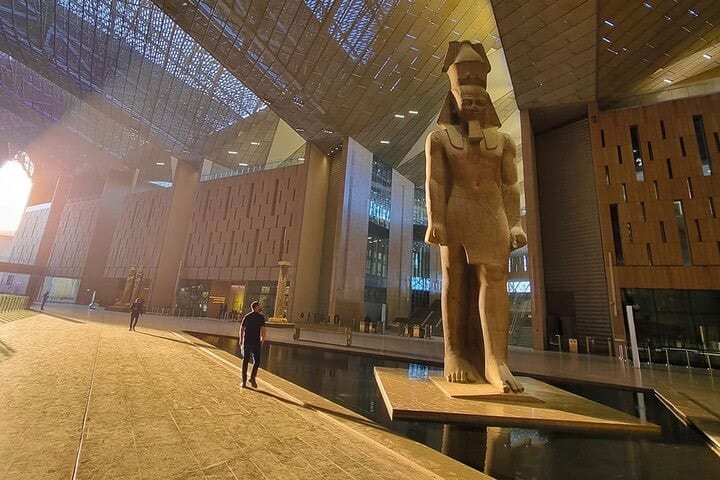
The Grand Hall (Atrium): Upon entering, visitors are greeted by the colossal, 83-ton statue of Ramesses II. This magnificent statue, which once stood in Cairo’s Ramses Square, now stands as the museum’s sentinel in its vast, light-filled atrium.
The Grand Staircase: Leading up to the main galleries is a majestic staircase lined with 87 royal statues and large architectural elements. This dramatic ascent will take visitors on a chronological journey through ancient Egyptian history, featuring masterpieces such as statues of kings Khafre and Menkaure, and a unique dual statue of Tutankhamun with the god Amun.
The Solar Boats of Khufu: The museum will also be the new home for the famed Solar Boats of King Khufu, the builder of the Great Pyramid. These meticulously reconstructed ancient vessels, which were buried near the pyramids, are masterpieces of ancient naval engineering and hold deep symbolic importance in funerary beliefs.
Conservation and Research: Beyond its exhibition halls, the GEM houses a massive, world-class conservation center. Equipped with 17 laboratories, this center is dedicated to the study, restoration, and preservation of Egypt’s priceless heritage, with some labs even visible to visitors.

Read more” Why Nubian Village Should Be on Your Egypt Bucket List
Mission and Significance
The Grand Egyptian Museum aims to provide a richer, more contextualized narrative of ancient Egyptian civilization. By uniting collections that were previously dispersed or held in storage, it will offer a more comprehensive understanding of the life, beliefs, and artistry of the pharaohs. Its proximity to the Giza Pyramids creates a powerful historical and geographical link, allowing visitors to experience the monuments and the artifacts created for them in a single, integrated visit. As it prepares for its grand debut, the GEM is set to redefine the museum experience and secure its place as the world’s foremost institution for ancient Egyptian history.
Where is the Grand Egyptian Museum located?
The Grand Egyptian Museum (GEM) is located in Giza, Egypt, approximately 2 kilometers from the Giza Pyramid Complex. Situated on the Cairo-Alexandria Desert Road, the museum occupies a 50-hectare site at Alexandria Desert Road, Kafr Nassar, Al Haram, Giza Governorate, Egypt .
The museum is currently in a soft opening phase, allowing limited access to certain areas. Visitors can explore the main galleries, Grand Hall, Grand Staircase, commercial area, and exterior gardens. However, access to the Tutankhamun galleries and the Khufu’s Boats Museum is restricted until the official opening .